The Prostitution Statistics You Have to Know
📅 2026 Update: Changes in Prostitution and Human Trafficking Statistics
Since the original article was published, significant changes have occurred in prostitution and human trafficking statistics. These updates reflect shifts in law enforcement, victim support, and the overall landscape of sex offenses in the United States. The earlier article continues further down the page for more detailed information.
📉 Prostitution Arrests Decrease in South Carolina
In 2024, South Carolina reported a total of 152 prostitution offenses. This marks a 77.1% decrease from 2023, when there were 665 offenses. This dramatic drop may indicate changes in law enforcement strategies or social attitudes toward prostitution in the state.
🚨 National Human Trafficking Hotline Cases
The National Human Trafficking Hotline identified 11,999 cases involving 21,865 victims in the United States in 2024. These numbers highlight the ongoing issues surrounding human trafficking and the need for continued efforts in prevention and support.
📊 Economic Impact of Commercial Sex
The annual economic impact of commercial sex in the U.S. is estimated at $9.5 billion. This figure includes direct earnings, industry spending, and tax revenue. Understanding this economic aspect can help inform discussions about policy and reform in sex work.
📚 Human Trafficking Data Collection
In January 2026, the Bureau of Justice Statistics (BJS) released a report detailing arrests, prosecutions, convictions, and sentences related to human trafficking offenses. This report is key for understanding the effectiveness of current laws and the justice system in addressing these crimes.
📌 Key Updates on Prostitution and Trafficking
- 📉 South Carolina saw a 77.1% decrease in prostitution offenses from 2023 to 2024.
- 🚨 The National Human Trafficking Hotline identified 11,999 cases involving 21,865 victims in 2024.
- 📊 The economic impact of commercial sex is estimated at $9.5 billion annually.
- 📚 A new BJS report released in 2026 provides valuable data on human trafficking offenses.
💡 Tips for Understanding Prostitution and Human Trafficking Laws
Reviewing details of your situation with an attorney can provide clarity on your specific legal issues.
📑 Understand Local Laws
Each state has different laws regarding prostitution and human trafficking. Knowing the specific laws in your area can help you navigate this complex issue.
🚨 Report Suspected Trafficking
If you suspect someone is a victim of human trafficking, report it to the National Human Trafficking Hotline. This hotline connects victims with the necessary services and support.
📊 Stay Informed on Data Collection
The Bureau of Justice Statistics regularly releases reports on human trafficking. These reports can provide insights into trends and help inform public policy.
💬 Utilize Support Services
Take advantage of free resources like the National Human Trafficking Hotline. They provide 24/7 access to support and services for victims of trafficking.
📅 Keep Track of Changes
Laws and statistics can change frequently. Staying updated on the latest information regarding prostitution and human trafficking can help you stay informed.
🏆 Free Options Ranked by User Reviews (2026)
No national paid service in this area met the review threshold, so this section lists free government and nonprofit resources named in FACTS instead.
🥇 1. National Human Trafficking Hotline
The National Human Trafficking Hotline is a free, non-governmental service available 24/7. It connects victims and survivors of sex and labor trafficking with essential services and support.
🥈 2. Bureau of Justice Statistics (BJS)
The Bureau of Justice Statistics conducts data collection activities related to human trafficking. Their reports provide valuable insights into arrests, prosecutions, convictions, and sentences.
🥉 3. Polaris
Polaris operates the National Human Trafficking Hotline and provides various resources for victims and advocates. They focus on prevention efforts and support for those affected by trafficking.
4️⃣ Local Law Enforcement Agencies
Local law enforcement agencies can provide information on reporting trafficking and prostitution offenses. They often have community resources available for victims seeking help.
5️⃣ Community Support Organizations
Many local organizations offer support services for trafficking victims. They can provide housing, legal assistance, and counseling to help individuals rebuild their lives.
🔎 What to Check Before Paying for Help
- 🔍 Verify that the service is a non-profit or governmental organization.
- 📋 Look for reviews or testimonials from past users.
- 🏢 Confirm the organization has a physical address and contact information.
- 📞 Ensure they offer 24/7 support for immediate assistance.
❓ Frequently Asked Questions
❓ What are the penalties for prostitution in South Carolina?
Penalties for prostitution in South Carolina can vary but may include fines and imprisonment. The severity often depends on repeat offenses and other factors.
🚨 How can I report human trafficking?
You can report suspected human trafficking by contacting the National Human Trafficking Hotline. They provide a safe way for individuals to report cases and seek help.
📉 Have prostitution arrests increased or decreased?
Recent data shows that prostitution arrests in South Carolina decreased significantly by 77.1% from 2023 to 2024. This trend reflects potential changes in law enforcement approaches.
📊 What does the Bureau of Justice Statistics report?
The Bureau of Justice Statistics provides reports that detail human trafficking offenses, including arrests, prosecutions, and convictions. Their findings can help inform public policy and awareness.
💬 How can victims find support?
Victims of trafficking can find support through the National Human Trafficking Hotline. This resource connects them to services designed to assist in recovery and safety.
📅 Are there recent changes in trafficking laws?
As of January 2026, there are ongoing efforts to update laws and data collection related to human trafficking. These changes aim to enhance support for victims and improve enforcement.
⚖️ Recent Cases Related to Prostitution and Trafficking
Recent court rulings have shed light on the evolving landscape of prostitution and human trafficking laws. These cases highlight the legal system's response to these critical issues.
- Ohio Court affirms trafficking conviction of Billy FlemmingOhio Court of Appeals · July 30, 2026
- New York court affirms conviction in child sex abuse caseAppellate Division of the Supreme Court of the State of New York · July 22, 2026
- Court upholds sex offender designation for Brandon SalisburyAppellate Division of the Supreme Court of the State of New York · July 15, 2026
- Court upholds designation of Azpeitia as level three sex offenderAppellate Division of the Supreme Court of the State of New York · July 15, 2026
For more recent rulings, browse more rulings on the news page.
End of October 2026 Update
Due to the underground nature of the illegal commercial sex industry, summing up the exact statistics on prostitution in the United States is difficult. Nevertheless, there are many accurate generalizations that could be concluded based on approximate statistical information regarding the topic of prostitution.
It is extremely clear that persons engaged in prostitution are not happy with their unfortunate choice of profession. Countless studies report that over 80% of prostitutes say they wish to get out of prostitution. This information does not explain why women do not get out of prostitution. There is plenty of statistically based studies on prostitutes reporting reasons why they do not quit their jobs and do something legitimate.
About 40% of prostitutes are former child prostitutes who were illegally forced into the profession through human trafficking or once were teenage runaways. Many of the runaways fled because their homes were abusive, poor, or did not approve of them. There is a nationwide trend of increased frequency of child prostitution as a result of runaways. Many men feel that they are safer from AIDS if they have sex with younger prostitutes, increasing the market for younger prostitutes. 60% percent of children reported missing as a result of running away become prostitutes for some period of time to survive.
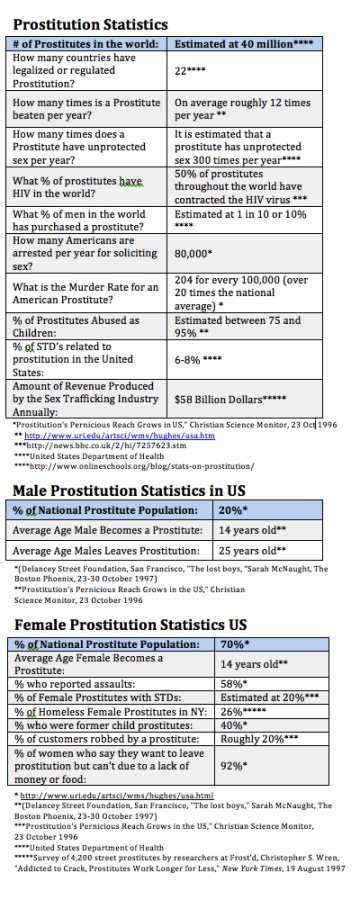
Many of these children are youths who fled their homes because of a parent or guardians disapproval. This accounts for the origins of many of the male prostitutes that walk the streets. Males prostitutes account for roughly 20% of the national prostitute population. The average age at which a male prostitute begins their illegal work is 14 years old. Male prostitutes usually do not have pimps as they usually work independently. This allows them to leave prostitution more easily at an average age of 25 years.
Female prostitution statistics tell a completely different story. The average female prostitute enters her job when she is only 16 or 17 years of age. Female prostitutes leave prostitution less frequently than their male counterparts. This is mainly because a smaller proportion of them work for pimps. They typically have shorter lives because they are subject to the abuse from both clients and pimps. 58% of American prostitutes reported violent assault at the hands of clients.
With a higher instance of physical violence perpetrated against them, female prostitutes are more likely to get murdered. In a period of five years in Newark, New Jersey, 14 homicide victims were known prostitutes. That is an incredibly high figure in a city of 280,000 residents with an average annual murder rate of 7 homicides per 100,000 persons.
Roughly 26% of New York City prostitutes were homeless and addicted to illicit drugs. They had to resort to prostitution to serve their addiction to hard drugs like crack, cocaine, and heroin. 90% of New York City prostitutes had to give away at least one child to child protective services.
This is a common occurrence across the country and contributes to the incidence of children without parents. According to the United Nations, there are approximately 311,600 orphans in the United States alone. There are no statistics that indicate the proportion of orphans who are born of prostitutes; however, it is clear that prostitutes would contribute to that figure.
Prostitutes have an increased incidence of sexually transmitted diseases. A study in Minneapolis, Minnesota revealed that only 15% of prostitutes who had prostituted for at least six months had an STD. This figure does not include HIV/AIDS. Gynecological examinations of the prostitutes in this study revealed an alarming incidence of positive pap tests.
These women are at greater risk of cervical cancer and could spread the human papilloma virus among the population of the Minneapolis-St. Paul metropolitan area, either through direct transmission or indirect transmission.